If you’ve ever held a titanium plate in your hands for the first time, you don’t just feel metal—you feel the kind of quiet confidence only a material that balances strength, lightness, and durability can give. As a supplier who’s been shipping titanium plates to aerospace, marine, medical, and industrial clients for over a decade, I get asked this question more than any other: How strong is a titanium plate? It’s not a one-word answer, and it’s not just about numbers on a spec sheet. It’s about what that strength means for the projects my customers build, and why titanium stands apart from every other metal they might have used before. Titanium Plate

Let’s start with the basics, because strength in metals isn’t a single thing. There’s yield strength—how much force a material can take before it permanently bends. Tensile strength, which is the maximum force it can handle before breaking. Hardness, which measures its resistance to scratches and dents. And toughness, which is its ability to absorb impact without cracking. For pure titanium, that yield strength hovers around 240 megapascals (MPa), and tensile strength hits roughly 430 MPa. That’s impressive on its own, but titanium alloys are where the real performance comes in. Our most common commercial grade, Grade 5 titanium (Ti-6Al-4V, made with 6% aluminum and 4% vanadium), has a yield strength of about 880 MPa and a tensile strength of up to 900 MPa. To put that in perspective: 430 MPa for pure titanium is stronger than 304 stainless steel, which checks in at around 205 MPa yield, and Grade 5 titanium is nearly as strong as some low-grade carbon steels, but it’s 45% lighter.
I see customers light up when they hear that stat. Take an aerospace engineer designing a wing component, for example. Every kilogram saved on an aircraft translates to thousands of dollars in fuel savings over its lifetime. If they swapped a steel plate for a Grade 5 titanium plate of the same strength, they’d cut the weight almost in half—no compromise on how much force that part can withstand during takeoff, turbulence, or landing. For marine applications, that strength pairs with titanium’s natural corrosion resistance to make something that won’t rust or pitting in saltwater, even after decades. I’ve supplied plates to shipyards that build offshore wind farm foundations, and they tell me the same plate that would need replacement every 10 years if made of steel still looks like new after 25.
But strength isn’t just about static force. It’s about toughness, too. A few years back, a customer in the defense industry called me in a panic—they’d dropped a 50-pound steel plate during a test, and it dented so badly they had to scrap it. They tried a pure titanium plate as a replacement, and when they accidentally dropped it from 20 feet onto a concrete slab, it didn’t crack. It didn’t even bend enough to need rework. Pure titanium’s toughness is one of its most underrated traits, especially at low temperatures, which is why it’s used for parts in spacecraft and Arctic drilling equipment. Most metals get brittle when it’s cold, but titanium stays flexible and strong.
Of course, not all titanium plates are the same. The strength changes depending on the grade, the manufacturing process, and even the thickness. Pure titanium plates, for example, are softer and more malleable—great for medical implants like hip replacements, where the bone needs to grow around the material, but not ideal for high-stress structural parts. Grade 5 is the workhorse for most industrial and aerospace uses, but we also work with Grade 2, which is a little softer than Grade 1 but has better formability, perfect for parts that need to be bent or shaped on-site. For customers who need extreme strength, we offer Grade 23 titanium, which has a yield strength of up to 950 MPa and is often used in critical medical devices or high-performance racing components.
Thickness matters, too. A 1mm titanium plate is going to be much less strong than a 5mm one, and how it’s rolled or forged changes its internal structure. When I first started in this business, I thought all titanium plates were made equal—just cut to size, shipped out. I learned quickly that’s not true. Our plates go through a hot rolling process that aligns the titanium’s grain structure, which makes it stronger than cold-rolled plates that are cheaper but more likely to crack under sudden impact. A customer building pressure vessels for chemical processing told me they saved 30% on initial costs with cold-rolled titanium plates, but they failed a pressure test six months later. They switched to our hot-forged Grade 5 plates, and they haven’t had a single failure since.
I’ve also seen customers underestimate how strength interacts with other properties. For a dentist designing a custom crown, a pure titanium plate is strong enough, but its biocompatibility is what matters most—no one wants a material that reacts with the human body. For a brewery building fermentation tanks, the plate needs to be strong enough to hold liquid under pressure, but also resistant to acids from beer, something titanium does better than almost any other metal. That’s another thing titanium plates offer that steel or aluminum can’t: a rare combination of strength and corrosion resistance that works in almost every environment, from jet engines to hospital operating rooms to deep-sea pipelines.
Let’s talk about something that’s often missed when talking about strength: fatigue strength. That’s how many cycles of force a material can handle before it breaks. For parts that move constantly—like aircraft landing gear, or wind turbine blades—fatigue is one of the biggest failure causes. Grade 5 titanium has a fatigue strength of around 275 MPa, which is far higher than aluminum’s 90 MPa or even some stainless steels. I had a wind energy client last year who told me their old steel plates on their turbine blades would fail after about 1.2 million rotations. They swapped to our Grade 5 titanium plates, and they’ve already gone past 5 million rotations with no signs of wear. That’s not just strength—that’s longevity.
Now, I know some of you might be thinking, “Why not just use a stronger metal?” Like, why not go for a high-strength steel that’s harder than titanium? The answer is weight. High-strength steel has a yield strength of around 550 MPa, which is less than half of Grade 5 titanium, and it’s 7800 kg per cubic meter compared to titanium’s 4500 kg per cubic meter. So a steel plate that can handle 5 tons of force weighs about twice as much as a titanium plate that can handle the same—for most projects, that extra weight adds up to higher costs in fuel, installation, or structural support. It’s not that steel is weak; it’s that strength isn’t just about numbers—it’s about matching the material to the job.
I’ve seen this play out in small projects too, not just big industrial ones. A few years back, a local artist contacted me looking for a titanium plate to make a large outdoor sculpture. They had a stainless steel plate that kept bending in the wind, and aluminum that was too soft. The Grade 5 titanium plate I sold them was lighter than the steel they’d used before, strong enough to withstand hurricane-force winds, and it didn’t rust, so the sculpture has stayed looking the same since 2019. That’s a small project, but it’s the same principle as an aircraft wing or a pipeline—strength paired with durability, weight, and corrosion resistance.
Of course, there are limits. Titanium isn’t unbreakable. If you try to pull a titanium plate beyond its tensile strength, it will break, just like any other metal. And at very high temperatures—above 600°C—its strength starts to drop, which is why jet engines use nickel-based superalloys for the hottest parts. But for 90% of the projects our customers work on, that limit is more than enough. I’ve never had a customer come back to me saying a titanium plate failed because it wasn’t strong enough—usually, the issues are about incorrect grade, wrong manufacturing process, or mismeasured thickness.
That’s why I make it a point to work closely with every customer, not just sell them a plate. When someone reaches out asking how strong a titanium plate is, I don’t just send them a spec sheet. I ask them: What is this plate going to be used for? What kind of forces will it be under? What environment will it be in? A customer building a wheelchair frame needs a different grade than someone building a submarine hull, and a different thickness than someone building a food processing tank. I’ve spent 12 years learning to match those needs, and that’s the service I offer along with every plate we ship.
If you’re in a project where strength matters—whether it’s aerospace, marine, medical, industrial, automotive, or even custom art and architecture—titanium plates offer a unique balance of properties that few other metals can match. They’re stronger than aluminum, lighter than steel, more corrosion-resistant than both, and tough enough to handle impact and fatigue over decades. But the “how strong is a titanium plate?” question doesn’t have a one-size-fits-all answer—because the right strength, for your specific project, is what matters most.
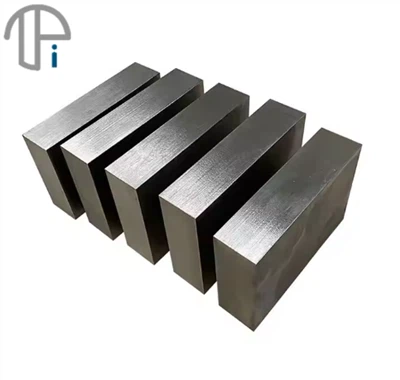
If you’re ready to explore how titanium plates can work for your application, or if you have questions about grades, thicknesses, or custom sizing, feel free to reach out to start a conversation about your needs.
Titanium Square Bar References:
- ASM International. (2007). Metals Handbook: Properties and Selection: Nonferrous Alloys and Special-Purpose Materials.
- Boyer, R. R. (1996). An Overview of Titanium Alloys. Materials Science and Engineering: A, 213(1-2), 1-12.
- NASA. (2020). Titanium Alloys for Aerospace Applications. NASA Technical Publication.
- International Organization for Standardization. (2018). ISO 5832-3: Implants for Surgery – Metallic Materials – Part 3: Wrought Titanium 6-Aluminum 4-Vanium for Surgical Implants.
- Marine Technology Society. (2019). Titanium Applications in Marine Engineering. Journal of Marine Engineering and Technology.
Baoji Top Titanium Industry Co., Ltd.
As one of the most professional titanium plate manufacturers and suppliers in China, we’re featured by quality products and good price. Please rest assured to buy bulk titanium plate in stock here and get quotation from our factory. Customized orders are welcome.
Address: No. 2, South Section Of Phoenix 2nd Road,High-Tech Zone, Baoji,Shaanxi, China (Mainland)
E-mail: sales@bjtopti.com
WebSite: https://www.china-topti.com/
